| Tweet |
Is 2025 the Right Time to Upgrade Your Family Home? Ottawa’s Market Trends Hold the Answer
For families in Ottawa dreaming of more space, better schools, and a neighborhood that feels like home, the 2025 real estate market offers new opportunities. If you’ve outgrown your current home and are ready to upgrade, understanding the latest market trends can help you make a smart move.
Here’s what to know about Ottawa’s real estate market as the new year begins.
A More Balanced Market for Buyers
Ottawa’s real estate market closed 2024 with signs of improvement. December saw a 7.9% increase in home sales compared to the previous year, a positive shift after a period of hesitation among buyers. While sales remain below historical averages, the rise in activity signals renewed confidence.
Active residential listings soared by 58.7% year-over-year, giving buyers more options to explore. For growing families, this means a greater chance to find a home with the extra bedrooms, backyard, or proximity to better schools that you’ve been looking for.
How Are Prices Trending?
Price trends are encouraging for those moving up the property ladder. The benchmark price for single-family homes in Ottawa rose to $729,300, up 3.7% compared to December 2023. Townhouses saw even more growth, with a benchmark price of $533,200, a notable 11.3% increase. Apartments, meanwhile, dipped slightly to $404,400, down 2.5%.
If you’re planning to sell your current home and upgrade, these trends work in your favor. You can maximize your sale price while investing in a property that better suits your family’s needs.
Favorable Mortgage Conditions
Late 2024 brought consecutive interest rate reductions, higher insured mortgage limits, and extended amortization options. These changes make upgrading to a larger home more attainable. With more flexible mortgage terms, you may find it easier to align your budget with your family’s goals for a new home.
Inventory Is Expanding
December 2024 saw 3,216 active listings, a sharp increase from the year before. This growing inventory gives families more options to explore. However, challenges remain-affordability is still an issue for many, and homes in sought-after neighborhoods with great schools remain highly competitive.
What to Look for in Your Next Home
If your family is preparing to make a move, here are some factors to prioritize:
- Space to Grow: Look for homes with additional bedrooms, larger living areas, and outdoor spaces to accommodate your family’s changing needs.
- Top-Rated Schools: Research neighborhoods known for excellent schools to set your children up for success.
- Long-Term Potential: Think ahead-choose a home that will meet your needs for years to come to avoid future moves.
- Neighborhood Amenities: Proximity to parks, grocery stores, and family-friendly activities can enhance your daily life.
Why 2025 Could Be the Right Time
Experts are cautiously optimistic about Ottawa’s market in 2025. According to the Ottawa Real Estate Board, improving conditions like growing inventory and favorable mortgage terms are creating opportunities for families ready to upgrade. While affordability and supply challenges remain, the first half of the year could be a golden window to find your next home.
Steps to Take Now
- Evaluate Your Current Home: Get an updated assessment of your home’s value to understand how much equity you can use for your next purchase.
- Explore Mortgage Options: Work with a lender to see how recent rate changes could expand your buying power.
- Start Watching Listings: With more homes hitting the market, this is a great time to familiarize yourself with properties in neighborhoods that match your wishlist.
2025: A Year for Big Moves
Ottawa’s market is shifting, creating new opportunities for families looking to upgrade. Whether you’re searching for more space, better schools, or a community that feels just right, this could be the year to make your move.
If you would like help reaching your real estate goals in 2025 click here to contact our team.
Oct 2024 Market Update: Consumer Confidence is Growing in Ottawa’s Housing Market
In Ottawa, more people are starting to feel confident about buying and selling homes. In October 2024, 1,179 homes were sold in Ottawa, up from last month. Although this is slightly below average compared to the last 5-10 years, it’s still a positive sign that people are getting back into the market.
Why People Feel More Confident
Many feel hopeful because the Bank of Canada recently lowered interest rates. Lower rates make it easier for people to afford mortgages, which can increase interest in buying homes. People may be waiting to see if rates drop even more, which could make buying a home more affordable.
Ottawa’s Housing Prices
- Single-Family Homes: The average price is about $724,500, up a bit from last year.
- Townhouses: These are around $506,900, showing a small increase.
- Apartments: Prices are about $407,500, which is a bit lower than last year.
Overall, the average price for homes sold in Ottawa was about $668,690, which is 1.2% higher than in October 2023.
More Homes for Sale
October saw a rise in new listings, meaning more homes were put up for sale. There were 2,089 new listings, a 10.4% increase from last year. This rise in inventory helps balance the market, giving buyers more options to choose from.
Supply Challenges
While more homes are listed, Ottawa still faces a supply shortage. The real estate board notes that the city needs more homes, especially affordable ones, to keep up with demand. They’re encouraging the use of new building methods, like prefabricated homes, and pushing for policies that help build affordable housing.
In summary, Ottawa’s real estate market is gradually improving, with more homes for sale and slight increases in home prices. Lower interest rates are helping to boost buyer confidence, though more affordable homes are still needed to balance the market.
All info, stats and graphics provided by the Ottawa Real Estate Board
The Ottawa Resale Market Stats – July 2022
Residential Resale Slowdown Begins A Shift Towards Balance |
|
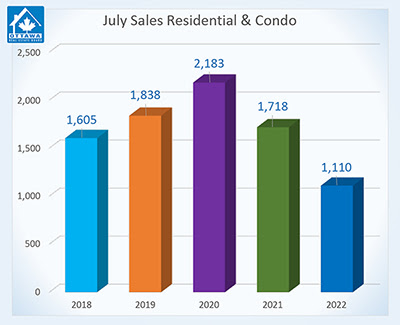
| Members of the Ottawa Real Estate Board sold 1,110 residential properties in July through the Board’s Multiple Listing Service® System, compared with 1,718 in July 2021, a decrease of 35 per cent. July’s sales included 840 in the residential-property class, down 36 per cent from a year ago, and 270 in the condominium-property category, a decrease of 34 per cent from July 2021. The five-year average for total unit sales in July is 1,691.
“We are witnessing a profound slowdown in Ottawa’s resale market. July’s numbers reveal that Buyers are indeed putting on the brakes more heavily than what is typically expected during the mid-summer sales dip. Aggressive interest rate increases are surely impacting the decision to buy at the moment as well as other factors that I mentioned last month,” states OREB President Penny Torontow. “But there is a silver lining: with more properties continually being added to inventory, we are on the cusp of returning to a balanced market, and that is good news,” she adds.
“July saw 2,338 new listings added to the housing stock, which is on par with the 5-yr average and 5% lower than last year at this time. Our inventory for residential-class properties is currently around 2.9 months and 2.5 months for condominiums. A market is considered balanced with at least four months of supply, so we are well on our way to that paradigm.” The average sale price for a condominium-class property in July was $425,694, an increase of 1 per cent from 2021, while the average sale price for a residential-class property was $716,354, increasing 5 per cent from a year ago. With year-to-date average sale prices at $805,238 for residential and $461,557 for condominiums, these values represent an 11 per cent and 9 percent increase over 2021, respectively.* “The double-digit average price increases that we saw in the past couple of years right up until the early spring have now morphed into single-digit increases, which aligns more with our traditional stable year-over-year price growth. However, it is important to point out that average prices tally the entire spectrum of home sales across the city and region. If you look from neighbourhood to neighbourhood, there are so many differing characteristics and attributes, price increases will certainly fluctuate depending on where you live,” suggests Torontow. “If you are selling your home, now is the time to be patient as days on market return to more normal timeframes. There are still many Buyers out there, but with more choice, they have less pressure and may take their time. Even though interest rates are still quite reasonable from a historical perspective, consumers are adjusting to this new reality. The rising cost of all goods means people need time to evaluate and adapt their mindsets.” “I also believe it is time for the federal government to adapt and reassess the stress test. It was originally designed when rates were very low to ensure Buyers could manage rate hikes. With interest rates where they are now, they have to qualify at a 7-8% rate which no longer makes sense and takes many Buyers out of the market.” “Whether you are a Buyer or a Seller, a professional licensed REALTOR® will help you navigate this shifting resale market. They have access to minute-by-minute sales data and local neighbourhood expertise that will assist you in making the best decisions for your circumstances.” REALTORS® also help with finding rentals and vetting potential tenants. Since the beginning of the year, OREB Members have assisted clients with renting 3,528 properties compared to 2,706 last year at this time. * OREB cautions that the average sale price can be useful in establishing trends over time but should not be used as an indicator that specific properties have increased or decreased in value. The calculation of the average sale price is based on the total dollar volume of all properties sold. Price will vary from neighbourhood to neighbourhood. |
For a more in depth look at your home please contact Steve Benson.
The Ottawa Resale Market Stats – June 2022
Residential Resale Market’s Shifting Benchmark Reality |
|
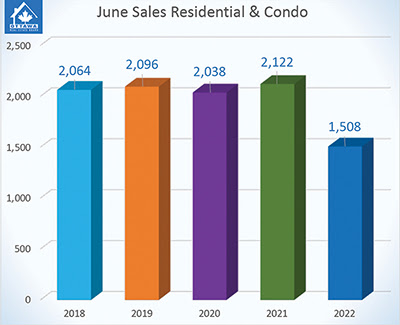
| Members of the Ottawa Real Estate Board sold 1,508 residential properties in June through the Board’s Multiple Listing Service® System, compared with 2,122 in June 2021, a decrease of 29 per cent. June’s sales included 1,138 in the residential-property class, down 31 per cent from a year ago, and 370 in the condominium-property category, a decrease of 23 per cent from June 2021. The five-year average for total unit sales in June is 1,966.
“After the frenzy of the past two years, we are witnessing Ottawa’s resale market normalize in 2022 and shift towards the more traditional seasonal ebb and flow cycle. While June transactions do typically taper as many look towards their summer holidays, last month’s sales were at a slower pace than we have seen in well over a decade,” states Ottawa Real Estate Board President Penny Torontow. “We can likely attribute the decrease in unit sales to economic factors such as rising interest rates and cost of living/inflation. Other dynamics could include Buyer fatigue combined with a wait-and-see approach towards home prices, lack of confidence amongst consumers, and perhaps the uncertainty surrounding back-to-work arrangements as a long commute with rocketing gas prices will certainly affect decisions about where to live,” she adds.
The average sale price for a condominium-class property in June was $438,977, an increase of 1 per cent from 2021, while the average sale price for a residential-class property was $772,861, increasing 6 per cent from a year ago. With year-to-date average sale prices at $815,797 for residential and $465,573 for condominiums, these values represent an 11 per cent and 10 percent increase over 2021, respectively.* “It’s no secret that price increases have become more modest in the last two months–there’s a new benchmark reality in Ottawa. While our average price statistics provide an overall picture, as the market settles, there will be adjustment differences in various pockets of the city. For example, what happens in Westboro will not likely mirror Findlay Creek,” advises Torontow. “But even as prices fluctuate, historically, real estate in Ottawa has always been and will continue to be stable and dependable in the long term. We aren’t likely to ever experience the significant dips that other regions may see. Prices won’t fall out; they are prone to level off to the reasonable rates of increase that we have historically experienced.” “With an influx of 3,213 new listings in June, we are moving (albeit gradually) towards the goal of a more balanced market. Residential inventory has increased by 38% over last year at this time and is sitting at an approximate 1.9 months’ supply currently. Condominium housing stock has risen 14% to a 1.6 months’ supply for that property class. Once government-pledged supply measures are enacted, we are optimistic that goal is within reach.” “Buyers, if you have been waiting on the sidelines, this may be an optimal time to venture back into your home search. There is more selection, fewer bidding wars, and less pressure to make a warp-speed decision. As for Sellers, your neighbourhood has its own characteristics and attributes that should weigh into the calculation of your property’s value. Contact a professional REALTOR® who has their hand on the pulse of Ottawa’s shifting real estate market today!” REALTORS® also help with finding rentals and vetting potential tenants. Since the beginning of the year, OREB Members assisted clients with renting 2,919 properties compared to 2,252 last year at this time. |
For a more in depth look at your home please contact Steve Benson.
The Ottawa Resale Market Stats – May 2022
Ottawa’s May Residential Resales Underperform Expectations |
|
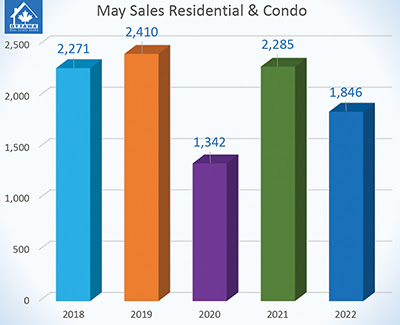
| Members of the Ottawa Real Estate Board sold 1,846 residential properties in May through the Board’s Multiple Listing Service® System, compared with 2,285 in May 2021, a decrease of 19 per cent. May’s sales included 1,384 in the residential-property class, down 22 per cent from a year ago, and 462 in the condominium-property category, a decrease of 11 per cent from May 2021. The five-year average for total unit sales in May is 2,031.
“With year-over-year resales declining in March and April, and now with this downward trend continuing into May, traditionally the highest performing month for resales, it is quite clear that Ottawa’s resale market is shifting away from the blazing pace of 2021,” states Ottawa Real Estate Board President Penny Torontow. “And if rising interest rates, cost of living, and inflation aren’t enough factors to cause a pullback, the powerful and deadly storm that brought our city to its knees last month has justifiably impacted the market as well.” “Our data shows a sharp decline in new listings with a corresponding increase in cancelled/suspended listings on the MLS® System in the period following the storm. Overall, in May, however, there were 3,120 properties that entered the market. This is on par with last May and is 5% over the 5-year average. The result is an 18% increase in residential-class inventory. Meanwhile, there was a slight decline (0.4%) in condominium inventory, but this is not surprising since they have likely become an entry point for many first-time homebuyers due to the affordable price point.”
The average sale price for a condominium-class property in May was $472,920, an increase of 11 per cent from 2021, while the average sale price for a residential-class property was $802,393, increasing 8 per cent from a year ago. With year-to-date average sale prices at $824,276 for residential and $470,353 for condominiums, these values represent a 12 per cent increase over 2021 for both property classes.* “Average prices, while still higher than 2021, are showing signs of adjusting to the pace of the market with a month-over-month decrease of 2% in both property classes. In April, we also saw a decline of 1-3%. In contrast, January to March experienced month-to-month increases ranging from 2% to 12%. This may be good news for Buyers, including the fact that the months of inventory have increased to 1.2 for residential and 1 month for condominiums. We are still a far cry away from a balanced market, but it finally seems to be moving in the right direction,” Torontow suggests. “Additionally, another statistic that we see increasing is the cumulative days on market (CDOM), which is now 14 days, increasing from 11 days last May. CDOMs are typically between 30-60 days in a balanced market, and usually closer to that one-month mark in Ottawa. I mention this because we don’t want Sellers to panic if their homes aren’t selling as quickly as perhaps their neighbours’ properties did. Buyers will also have a little more breathing room if this trend continues.” “But at the end of the day, each property for sale has its own hyper-local market factors (location, condition, other properties for sale in the same neighbourhood, etc.) that will affect the final sale price. If you want to know the most accurate price point to sell your home or what is the true market value of a home you are interested in, a licensed professional REALTOR® has the education and the experience with access to the most current market statistics and property information, to guide you into making the optimal decision for you and your budget.” REALTORS® also help with finding rentals and vetting potential tenants. Since the beginning of the year, OREB Members assisted clients with renting 2,320 properties compared to 1,837 last year at this time. |
For a more in depth look at your home please contact Steve Benson.
The Ottawa Resale Market Stats – March 2022
March Resales Indicate Strong Spring Market |
|
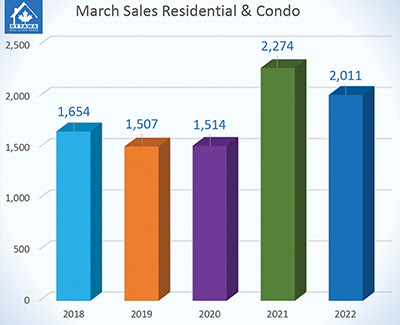
| Members of the Ottawa Real Estate Board sold 2,011 residential properties in March through the Board’s Multiple Listing Service® System, compared with 2,274 in March 2021, a decrease of 12 per cent. March’s sales included 1,493 in the residential-property class, down 12 per cent from a year ago, and 518 in the condominium-property category, a decrease of 10 per cent from March 2021. The five-year average for total unit sales in March is 1,792.
“Although the number of sales in March decreased from last year at this time, it was still a robust and busy start to the spring season. Transactions increased 42% over February (590 units) and were 12% higher than the 5-year average. Last March was unseasonably warm in comparison, and the lion-like weather that pervaded most of this March may have played a role. More likely, the lifting of some restrictions and opportunity for unfettered travel during the spring break had peoples’ attention turning towards other activities during the month,” states Ottawa Real Estate Board President Penny Torontow. “March tends to be the early indicator of the spring resale market pace, so we anticipate April’s numbers will be a better indication of just how the spring market will perform, which tends to be the peak time of year for resales,” she adds.
The average sale price for a condominium-class property in March was $479,405, an increase of 10 per cent from 2021, while the average sale price for a residential-class property was $853,615, increasing 13 per cent from a year ago. With year-to-date average sale prices at $831,122 for residential and $467,915 for condominiums, these values represent a 14 per cent and 13 percent increase over 2021, respectively.* “Average prices continue on their upward trend, albeit only increasing 2-3% over February’s figures, the year over year percentage increases of 13-14% validate that the housing supply shortage will continue to put strong upward pressure on prices until that is remedied.” “Last month saw 2,632 new listings enter the MLS® System, and although 6% lower than March 2021, this is still 4% (or 100 units) above the 5-year average. Residential-class property inventory is approximately 10.5% higher than last year at this time, with condominium-class inventory down 12%. Overall, we are just slightly over (.6%) a half month’s supply of inventory and require at least four months of inventory to be considered within a balanced market.” “It is encouraging to see new inventory entering the resale market. However, these properties are being quickly absorbed due to the unrelenting high demand, and more listings are crucial to meeting this need,” Torontow advises. “We appreciate the provincial government has introduced the first phase of its More Homes For Everyone Act to tackle the housing shortage by implementing measures, including working with municipalities to get homes built faster and increasing the Non-Resident Speculation Tax. This is a good start, and we are hopeful that with the application of these and further measures, Ottawa’s many potential home buyers waiting on the sidelines will finally be able to get a foothold in our local market.” In addition to residential sales, OREB Members assisted clients with renting 1,291 properties since the beginning of the year compared to 1,079 by March 2021. |
For a more in depth look at your home please contact Steve Benson.
The Ottawa Resale Market Stats – February 2022
Has Spring Sprung Early in Ottawa’s Resale Market? |
|
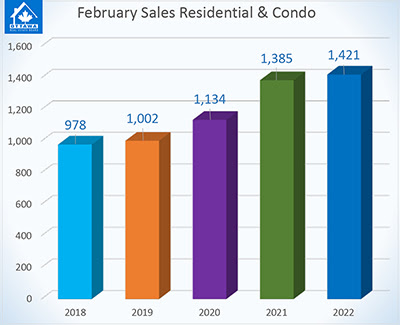
| Members of the Ottawa Real Estate Board sold 1,421 residential properties in February through the Board’s Multiple Listing Service® System, compared with 1,385 in February 2021, an increase of 3 per cent. February’s sales included 1,095 in the residential-property class, up 7 per cent from a year ago, and 326 in the condominium-property category, a decrease of 10 per cent from February 2021. The five-year average for total unit sales in February is 1,184.
“Although February’s resales were only 3% higher than last year at this time, we saw a 52% increase in the number of transactions compared to January’s figures (936). While a month-to-month increase is typical for this time of year, the gradation of this increase is higher than previous years, which could be an indication that our spring market may ramp up earlier this year,” states Ottawa Real Estate Board President Penny Torontow. “Whether this has to do with the easing of government pandemic restrictions and the opening up of the economy or perhaps due to apprehension of the (then) upcoming interest rate increase, which is now in effect, we can’t entirely be sure,” she adds. “We are watching intently to see how the 2022 spring market will play out considering not only the higher interest rates and inflation but also other macro factors in our global environment that could affect our local economy.”
“Undoubtedly, the interest rate increase along with the higher rate of inflation will weaken potential Buyers’ purchasing power. And even though average price growths are not as acute as they were in the past two years, we are still seeing significant increases that are without question a result of the unrelenting high demand and current housing stock scarcity.” The average sale price for a condominium-class property in February was $466,682, an increase of 15 per cent from 2021, while the average sale price for a residential-class property was $837,517, increasing 17 per cent from a year ago. With year-to-date average sale prices at $812,813 for residential and $458,107 for condominiums, these values represent a 16 per cent increase over February 2021 for both property classes. * “The number of new listings in February (1,762) offers a slight glimmer of hope for prospective Buyers. At 4% higher than the five-year average and 12% higher than February 2021, it resulted in an almost 10% increase in residential-class property inventory compared to last year at this time. Condominium supply, however, is down 20%. Overall, we are now at a 0.7 month’s supply of inventory which means that most listings that enter the market are going to be snapped up very quickly, as evidenced by the continuous decline in Days on Market (DOM). We certainly hope this trend of increased new listings will continue to supplement the housing stock going forward,” Torontow acknowledges. “Ottawa is a beautiful city with a healthy, stable economy and is a utopic place to work, live and play. It attracts Canadians from other cities and people from all over the world. But it is deeply entrenched in a Seller’s Market. This means homebuyers need to have all their ducks in a row and are prepared to move expeditiously. A REALTOR® will have the knowledge to ensure you are making your best offer at the optimal time. Sellers also need the experience and resources a REALTOR® brings to ensure they are strategically positioning their homes given the conditions of their neighbourhood and property type. Don’t gamble with what is likely your biggest asset – contact a professional REALTOR® today!” In addition to residential sales, OREB Members assisted clients with renting 800 properties since the beginning of the year compared to 674 by February 2021. |
For a more in depth look at your home please contact Steve Benson.
